
What are REITs – and do they exist in Austria?
REITs (Real Estate Investment Trusts) are publicly traded companies that own real estate and distribute rental income to shareholders in the form of dividends. Austria still does not have an established domestic REIT market, as the necessary tax legislation has yet to be introduced.
Nevertheless, thousands of Austrians search for this type of investment every year because the concept is appealing: regular income from real estate without having to purchase a property yourself.
How does a REIT work?
A REIT operates much like a real estate fund that is traded on the stock exchange. The company acquires properties – such as office buildings, residential complexes, or hotels, and generates income by renting them out. The rental income is then distributed directly to shareholders.
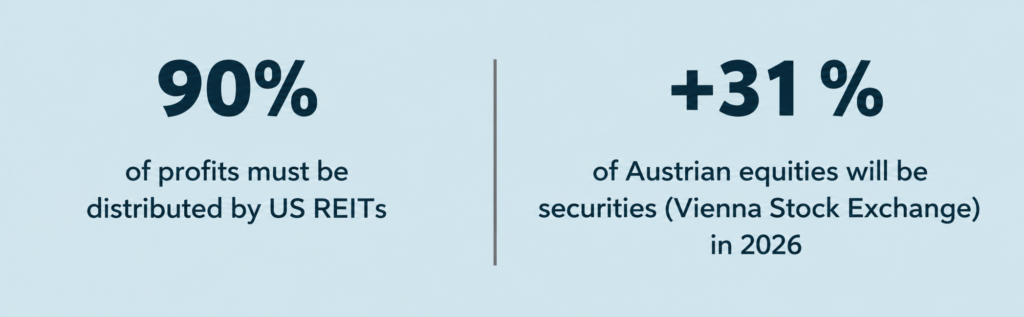
In the United States, where REITs have existed since the 1960s, they are legally required to distribute at least 90% of their taxable income to investors. This makes them particularly attractive for income-focused and dividend investors.
For comparison, the FTSE EPRA Nareit Developed Index, the global benchmark for REITs, delivered a total return of approximately 10.6% in 2025, while U.S. REITs achieved around 4.5%. European and Asian REIT markets performed significantly stronger during the same period.
Advantages of REITs
REITs can be traded on the stock exchange every day, making them significantly more liquid than a direct real estate investment. Even with small amounts of capital, investors can build a diversified real estate portfolio without having to deal with property management, rental agreements, or maintenance.
Historically, REITs have performed particularly well during periods of inflation. On average, they have outperformed the S&P 500 by approximately 3.6% per year during inflationary environments.
Disadvantages of REITs
REITs are still stocks, which means their prices fluctuate daily alongside the broader capital markets. Investors who held REITs in 2022 experienced average losses of around 28%.
There is also no direct connection to a specific property. Investors do not receive a land registry entry, nor do they own a tangible asset in a traditional sense. For Austrian investors, there is an additional challenge: a domestic REIT market does not exist. Those looking to invest through Austrian providers simply do not have access to this investment structure.
Why are there no REITs in Austria?
The answer lies in tax legislation. REITs only work efficiently when profits remain tax-exempt at the company level and are taxed only at the investor level.
Germany introduced a dedicated G-REIT Act in 2007. However, its impact has been limited, as residential real estate was excluded from the framework. Austria has not taken this step to date.
As a result, investors in Austria who want to gain exposure to real estate without buying a property themselves, without management responsibilities, and with the potential for regular distributions need an alternative.
This is precisely where tokenized real estate investments come into play.
REITs vs. real estate tokens: a direct comparison
Tokenized real estate investments follow the same basic principle as REITs: multiple investors participate in real estate and benefit from rental income. The key difference lies in the structure and the connection to the underlying asset.
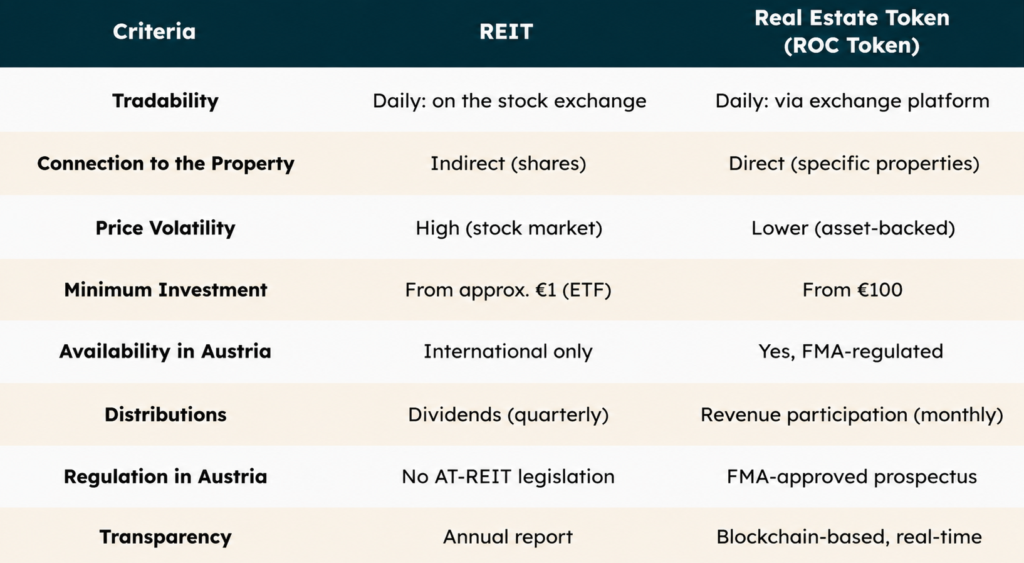
The most important advantage of tokenized real estate compared to REITs is simple: investors know exactly which properties they are investing in. Instead of owning shares in an abstract publicly traded company, investors gain exposure to real buildings whose performance and value can be transparently represented through blockchain technology.
The ROC Token: tokenized real estate with FMA approval
With the ROC Token, Rocksolid Estate has developed a model that brings the core idea behind REITs to the Austrian real estate market in a transparent, accessible, and legally compliant way.
The capital markets prospectus of Rocksolid Estate AG has been officially approved by the Austrian Financial Market Authority (FMA). This is not a marketing claim but a regulatory fact. Investors participate in a reviewed investment product with a clearly defined legal framework — a level of regulatory certainty that many international REIT structures cannot offer to Austrian investors.
What does the ROC Token actually represent?
The ROC Token represents participation rights in commercial and tourism-related real estate assets in Vienna — a city that consistently ranks among the most livable cities in the world and maintains strong demand for commercial property. Investors participate in ongoing income generation and potential value appreciation without being registered as direct owners in the land registry.
The entry barrier is significantly lower than that of purchasing a traditional apartment in Vienna. While a typical property today often requires a substantial amount of upfront capital, the ROC Token provides access starting with smaller investment amounts. The concept is similar to a REIT, but built on an Austrian legal and regulatory foundation.
Benefiting from the entire portfolio — not just a single property
This is one of the key differences compared to many other tokenized real estate models: holders of the ROC Token do not participate in just one individual property. Instead, returns are generated from Rocksolid Estate’s entire real estate portfolio, with all properties contributing collectively to distributions.
This creates built-in diversification within a single investment. If one property temporarily underperforms due to vacancy, renovation, or other factors, the broader portfolio can help offset the impact. This principle of diversification is one of the main reasons why REITs are so attractive to institutional investors. With the ROC Token, it is embedded directly into the structure.
Investor participation: helping shape the portfolio
What fundamentally differentiates Rocksolid Estate from traditional REITs and most other real estate token models is that investors have a genuine voice in key decisions.
Token holders can participate in votes regarding new property acquisitions and actively contribute to the future development of the portfolio. Rather than being passive participants in an anonymous investment vehicle, investors become part of the decision-making process.
In a publicly traded REIT, retail investors typically have no influence over which properties management decides to buy or sell. Rocksolid Estate takes a different approach by actively involving its investor community in strategic decisions. This not only increases transparency — it also creates trust and a stronger connection between investors and their investment.
Conclusion: REITs are a great concept — the ROC Token takes the idea further
REITs have helped democratize access to real estate investing. The core idea is compelling: investors pool their capital, gain exposure to real estate, and share in the returns. However, for Austrian investors, REITs remain largely an imported concept — there is no domestic REIT market, no local regulatory framework, and performance remains closely tied to stock market movements rather than directly to underlying real estate assets.
The ROC Token by Rocksolid Estate brings the REIT concept into the Austrian market while expanding upon it in several important ways: FMA-approved regulatory framework, portfolio-wide diversification across multiple properties, and investor voting rights that allow the community to participate in strategic decisions.
For investors seeking exposure to Austrian real estate with a low entry threshold, clear regulation, and an active role in shaping the portfolio, the ROC Token offers a solution that traditional investment structures have not been able to provide.
FAQ's
REITs are publicly traded real estate companies whose shares are bought and sold on stock exchanges. Real estate tokens, on the other hand, digitally represent economic rights linked to real estate assets. The key difference lies in the structure: while REITs typically operate through a publicly listed company, real estate tokens allow for a more direct and digital participation in specific properties or real estate portfolios.
Austria currently does not have an established domestic REIT market because the necessary tax framework is not in place. Austrian investors can invest in international REITs, but these are generally subject to foreign regulations and remain closely tied to stock market performance. This is one of the reasons why alternative models such as tokenized real estate are gaining increasing attention in Austria.
Yes, real estate tokens can serve as an alternative to REITs for Austrian investors seeking exposure to real estate income without purchasing property directly. At Rocksolid Estate, the ROC Token is based on a regulated structure and allows investors to participate in a diversified real estate portfolio with ongoing income generation, digital administration, and a clearly defined legal framework.
The ROC Token brings the core concept of REIT investing to the Austrian real estate market: multiple investors participate together in real estate assets and share in the returns. The difference lies in the digital structure, the FMA-approved regulatory framework, participation in the entire Rocksolid portfolio, and investor voting rights. This creates a modern and accessible approach to real estate investing in Austria.