
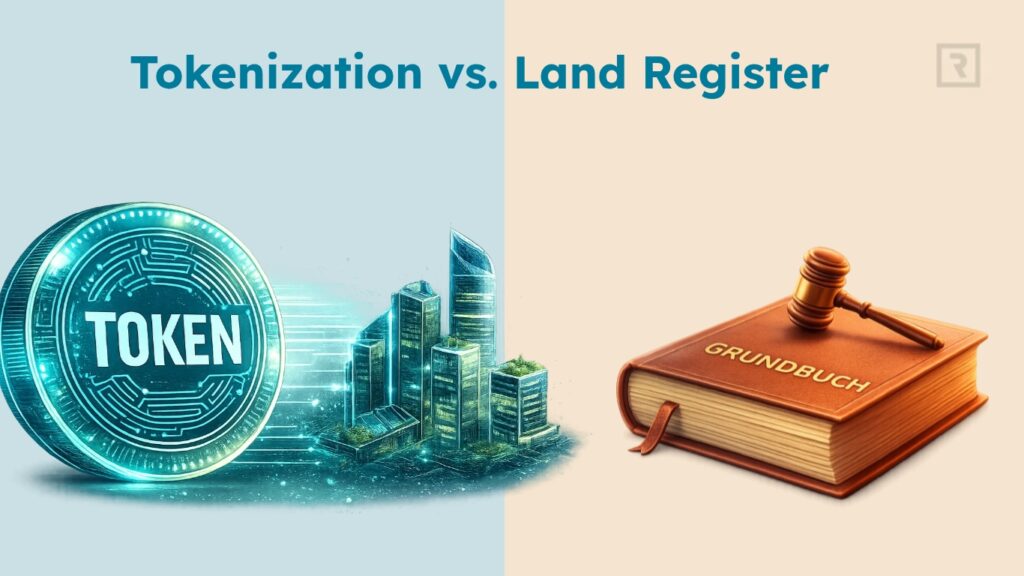
What is safer: tokenization or the land register for real estate?
Digital real estate investments through tokenization are not inherently less secure than a traditional land register entry — they are simply based on a different legal structure. While the land register records ownership directly, tokens represent economic claims through regulated vehicles. The key factors determining security are the legal framework, custody structure, and transparency — not the technology alone.
How does security work in the traditional land register?
The land register in Austria is a public register that documents ownership rights to real estate. An entry in the land register grants legal ownership and provides strong legal protection.
According to Statistik Austria, around 95,000 real estate transactions were recorded in the land register in 2023. The system is considered highly stable because it is administered by the state and legally secured through the courts.
Advantages of the land register system:
- Legally clearly defined ownership rights
- Strong enforceability in court
- Transparent ownership history
However, purchasing real estate in the traditional way usually requires significant capital.
In Austria, the average purchase price for condominiums in urban areas exceeds EUR 4,000 per square meter. In addition, transaction costs of around 7–10% apply (real estate transfer tax, registration fees, notary costs, and advisory services).
The land register therefore offers maximum legal security — but limited flexibility and high entry barriers.
What is the legal structure behind tokenized real estate?
Tokenization does not replace the land register digitally. Instead, a property is embedded within a legal structure — often through a project company (for example a GmbH). Investors acquire digital shares that represent economic rights within that structure.
In regulated models, tokens are issued under MiFID II–compliant frameworks. The token itself functions as a digital proof of participation or claim.
Globally, the market for tokenized real-world assets is growing rapidly. Industry analyses estimate that the market could reach several trillion US dollars by 2030. Institutional investors are increasingly testing tokenized structures to reduce transaction costs and improve liquidity.
It is important to understand:
- The token does not replace ownership in the land register
- It represents a legally defined economic claim
- Security depends on contractual structure and regulation
https://www.youtube.com/watch?v=tH6KT3EcbYw
Tokenization opens new possibilities for accessing real estate as an asset class. However, a clean legal structure, transparency, and regulated partners remain essential.
Rocksolid Estate AG combines traditional real estate projects with a digital participation structure, enabling investors to access structured real estate investments through digital shares.
Is the blockchain technology itself secure?
The underlying blockchain technology is considered technically very secure. Public blockchains such as Ethereum process transactions worth several trillion US dollars each year. Since its launch in 2015, the core protocol has not been compromised.
Security risks usually arise not from the blockchain itself, but from:
- Insecure wallet custody
- Lack of regulation
- Opaque project structures
In regulated models, digital shares are issued through verified issuers and structured processes. The blockchain primarily serves as a transparent documentation and settlement layer.
The advantage is that transactions are traceable, tamper-resistant, and more efficient than many traditional settlement processes.
How does the risk differ compared to traditional real estate ownership?
With a traditional property purchase, the owner bears:
- Market risk
- Maintenance risk
- Liquidity risk
- Financing risk
In tokenized models, risks are often structurally distributed. Investors can invest smaller amounts and diversify across multiple projects.
For example, someone who invests EUR 300,000 into a single property is fully dependent on the location and market performance of that asset. If the same amount is distributed across multiple shares of different tokenized properties, concentration risk is significantly reduced.
Statistically, the Austrian real estate transaction volume declined by around 40% in 2023 compared to the previous year — an indication of how strongly market cycles can affect traditional property owners. Digital structures enable more flexible entry and exit sizes.
Conclusion: Revolution or complement?
Tokenization does not replace the land register — it complements the real estate market with a digital participation layer. Security depends less on technology and more on legal structure, regulation, and transparency.
Digital real estate investments are not an unregulated “crypto trend,” but are increasingly evolving into a structured extension of traditional capital markets.
FAQ’s
Is a token as secure as a land register entry?
A token is not the same as a land register entry, but it can offer a comparable level of security when it is embedded within a regulated legal structure.
While the land register records direct ownership of a property, a token typically represents economic rights within a legal entity that owns the property. The level of security therefore depends on the legal framework, the contractual structure, and the transparency of the investment model.
In regulated structures, digital tokens serve as a transparent record of participation, while the underlying property remains registered in the land register.
What happens if interest rates in Austria continue to fluctuate?
Interest rate movements can influence the real estate market in several ways. Higher interest rates can make financing more expensive and may slow down property transactions. Lower interest rates can increase demand for real estate as an investment asset.
For investors, fluctuating interest rates can affect property valuations and financing costs. However, income-generating properties that produce stable rental cash flows can still remain attractive even in changing interest rate environments, especially when investments are diversified across multiple projects.
Why are digital real estate investments considered a revolution?
Digital real estate investments are considered transformative because they lower the barriers to entry and increase accessibility. Traditionally, investing in real estate required significant capital and direct property ownership. Through digital structures and tokenization, investors can participate with smaller amounts and gain exposure to multiple projects. In addition, digital infrastructures can improve transparency, transaction efficiency, and global access to real estate as an asset class.
Which platforms offer digital real estate investments in Austria?
In Austria, an increasing number of regulated platforms are emerging that offer tokenized real estate projects in compliance with MiFID II regulations. The key factors are transparency, a clear legal structure, and proper regulatory integration.
Rocksolid Estate works with regulated partners and provides investors with access to structured real estate projects through a digital participation layer.